Why I Switched from i3 to Sway: Following Wayland into the Future
The reasons I migrated from i3 (Xorg) to Sway (Wayland), what broke, what got better, and whether the switch was worth the migration cost.
i3 was perfect until it wasn't.
After two years of living in a tiling window manager, I started hitting walls that shouldn't exist. Fractional scaling was broken. HiDPI displays looked fuzzy. Clipboard managers were flaky. Input latency varied unpredictably. None of these were i3's fault—they were Xorg's fault, and Xorg is older than my career.
Wayland has been "the future" for longer than I'd like to admit, but it's finally here. And Sway—the Wayland equivalent of i3—is the only reason I considered jumping.
The Xorg Problem
Xorg is a network protocol from 1987. It was designed for dumb terminals connecting to workstations over a network. Modern displays, high DPI, touchpads, wacom tablets, and multiple monitors? Xorg jury-rigged solutions onto the protocol, and it shows.
By 2024:
- Fractional scaling was a hack that broke fonts
- HiDPI support required manual configs
- Screen tearing was endemic without perfect compositor setup
- Input latency was inconsistent across apps
- Screensharing required permission workarounds
None of this was "i3's problem." i3 is just a window manager. The problems lived in Xorg's foundation.
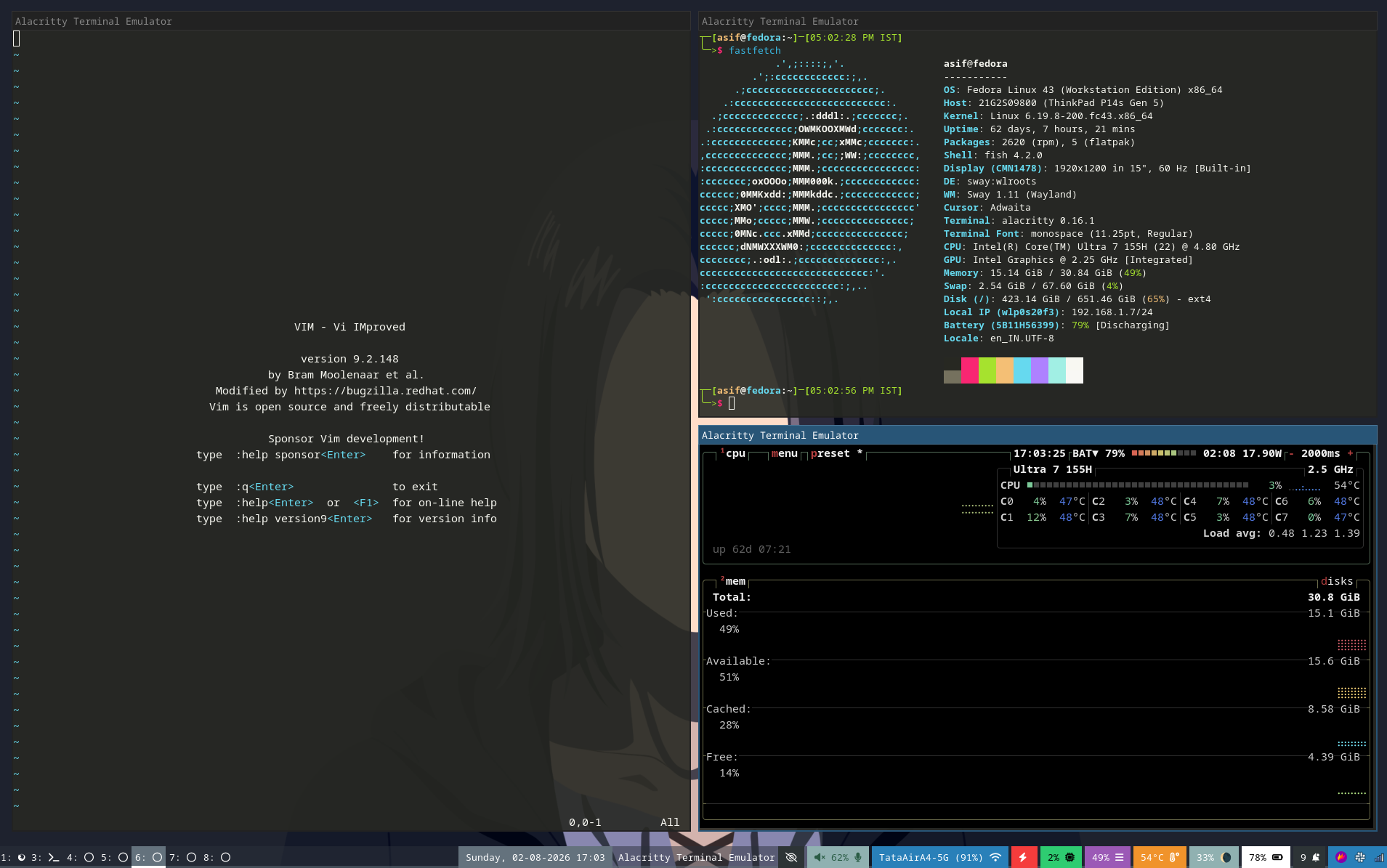
Why Sway
Sway isn't "i3 on Wayland." It's an almost-identical implementation of i3 that uses Wayland as its display protocol instead of Xorg. That means:
- Same keybindings (I didn't have to remap everything)
- Same configuration file format
- Same philosophy (keyboard-driven, tiling, minimal)
- Better rendering (Wayland handles this directly)
The pitch was simple: get i3's UX with Wayland's architecture underneath.
The Migration
I backed up my i3 config, renamed it, and started Sway. That's it.
Almost everything worked. My keybindings worked. My status bar (Waybar, the Wayland equivalent of Polybar) worked. My terminal (Alacritty) worked. My launcher (Rofi) mostly worked.
But there were casualties:
What Broke
Picom (compositor): Sway has Wayland rendering built-in. Picom is redundant. I lost the smooth shadows and window transparency I'd riced in, but Wayland's rendering is actually better (it doesn't tear, frame pacing is smoother).
Some screensharing tools: Zoom and some screen recorders needed permission rework. OBS worked out-of-box because it integrates Wayland capture natively.
X11-only apps: Some old apps still required X11. But in 2024, most of the tools I use have Wayland support.
Clipboard management: Wayland's clipboard is stricter (for security). The Wayland way is better, but some tools hadn't caught up.
What Got Better
Fractional scaling: Just works. A 1440p display on a 14" laptop? Scaling to 150% is clean. No blurry fonts.
Multiple monitors: The experience is noticeably more solid. No flickering when plugging/unplugging.
Input latency: Wayland handles input scheduling directly. The delay between my keystroke and the app response is imperceptibly lower.
HiDPI: No configs, no hacks. It just understands my display's DPI and scales correctly.
Screen tearing: Gone. Wayland's frame scheduling prevents the visual artifacts that plagued Xorg.
The Real Cost
Migration isn't free. I spent two days:
- Testing which tools had Wayland support
- Reconfiguring Waybar (Polybar doesn't support Wayland)
- Fixing screensharing for work calls
- Updating dotfiles
But here's the thing: I'm not paying that cost every day. Xorg was charging me that cost every time I plugged in a monitor or used a HiDPI laptop.
The Philosophical Shift
Switching from i3 to Sway forced me to think about why I use a tiling window manager. It's not the specific tool—it's the philosophy. Keyboard-driven, keyboard-optimized, no GUI overhead.
Sway delivers that philosophy with better fundamentals underneath. Wayland is how Unix should have solved displays if it had to start over today.
Would I Go Back?
No.
The migration was worth it. i3 was great because it was fast and direct. Sway is all of that, plus it doesn't fight against the OS for basic things like fractional scaling and frame scheduling.
The only reason to stay on Xorg in 2024 is legacy tooling. For new setups? Sway is the obvious choice.
My Sway configuration and Waybar setup are in my dotfiles repo.
The transition is easier than it sounds, and the gains are real.